The first chief doctor of the Nizhnekamsk dental polyclinic was congratulated on his 81st birthday
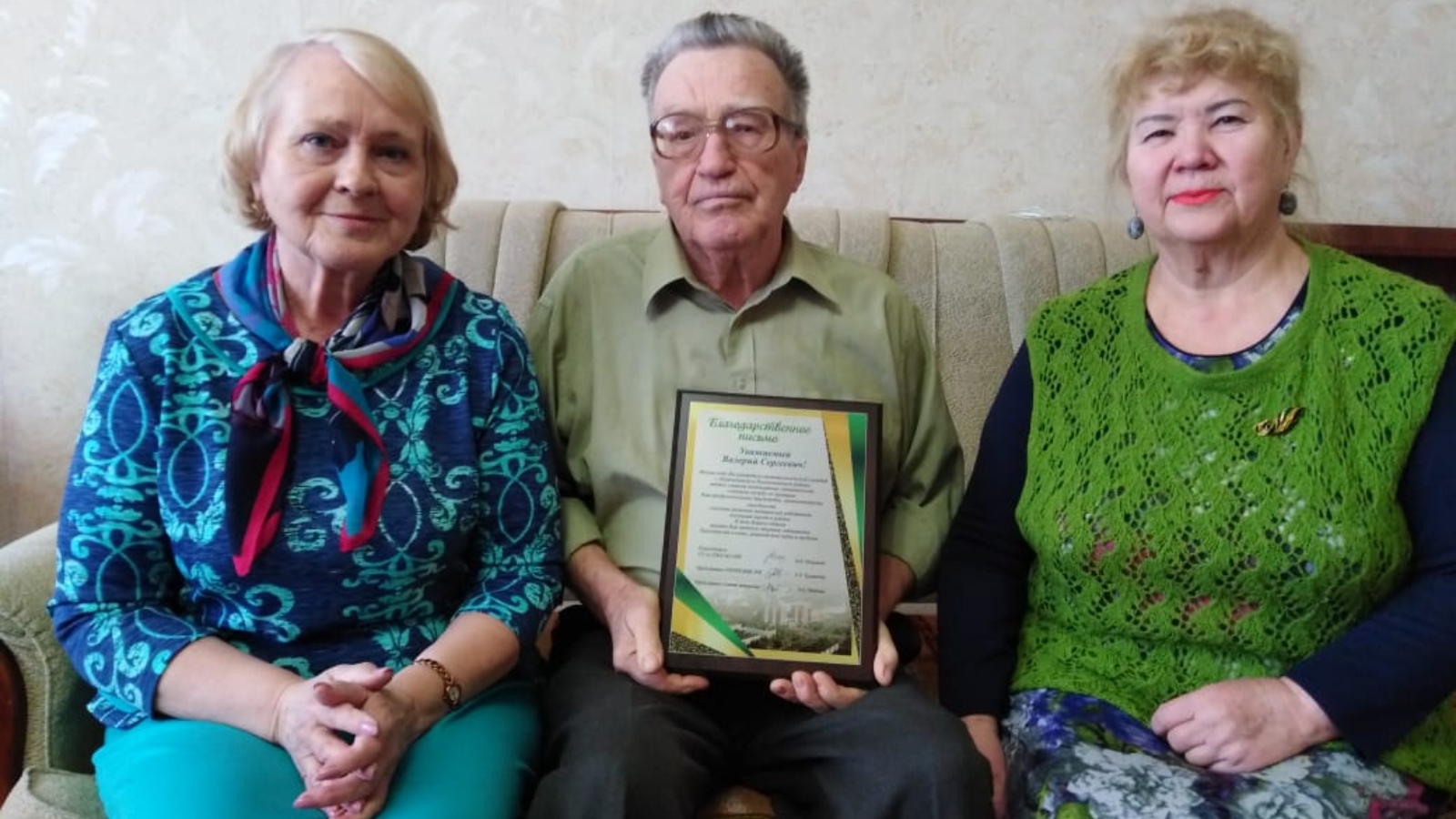
The first chief doctor of the dental polyclinic of Nizhnekamsk CRMB Valery Krupsky was congratulated on his 81st birthday by the staff of the Health Department.
Valery Sergeevich was at the origins of the dental service and led the polyclinic from 1969 to 2000, and then worked as a deputy chief physician. Under his leadership, the hospital introduced new methods of surgical and conservative treatment of adults and children. The dental clinic even became the best medical institution in Tatarstan – the hospital was the first in the republic to work with precious metals and residents of neighboring cities turned to doctors for the installation of gold crowns. Also, our polyclinic was the first to organize night shifts and patients no longer suffered toothache until the morning, then this practice was adopted by Chelny and Kazan.
Valery Sergeyevich was born in Khabarovsk, and since his father was a military man, the family moved to Turkmenistan, then to Azerbaijan. In 1962, he entered the Kazan Medical Institute (tr.: University), where he met his future wife Lina Muzagitovna, and after graduating from the institute, the young doctor was sent to the town of Balakovo in the Saratov region. Then the doctor returned to Kazan for a residency, but under a written promise that he would work only in Tatarstan; however, they gave him the opportunity to choose a city. "Then, in Nizhnekamsk there was only one house on the Youth, but there was the Kama (river) nearby, and I love fishing very much. So we came here,” shared Valery Sergeevich. “There was no dental clinic yet, only in the medical unit, which at that time was headed by Leonid Sergeevich Matrosov, there were several dental offices. I went to a surgical appointment and for the first few days I removed the patients' teeth. But then a patient with a jaw injury came in and I had to do maxillofacial surgery. I operated on adults with various facial injuries, and children, for example, with a hare lip."
"Of course, children do not remember the doctor who once helped them. Once I was standing in line at a car service station, two guys drove up, looked at me and said: "We are in a hurry, but you can wait." And I saw that one of the guys had a scar above his upper lip. I asked: "From where?". Naturally, I heard in response that it was none of my business, but I still added: "Didn't I operate on you when you were little?" Then the guys began to fuss, asked my last name – after all, parents tell their children about such cases, apologized and helped."
The dental service expanded, the offices moved to the building on Studencheskaya Street, where the prosecutor's office is now located. And before, The People's Court, the police, and gynecological, and dental offices coexisted there.
"My wife worked as a dentist with me. Situations at work can be different, I, as a manager, could make a remark to employees. And then these employees went to complain to my wife, and we, respectively, also had conversations on this topic. But that's not the case! Just at that time, I really lacked a surgeon, and the medical unit did not have a dentist. We discussed this issue with Leonid Sergeevich and my wife went to work in the medical unit, and I took one surgeon. So we killed two birds with one stone."
"Once, a patient came in with a broken jaw, I had to apply splints. If an arm or leg is broken, a plaster cast is applied to the limb, but you can not pour plaster into the mouth, so a metal structure is installed to immobilize the jaw, all teeth are fastened with special wire and rubber bands. Even for an experienced doctor, this procedure takes more than an hour. So, I installed this patient's splints, and he took them off and came to the appointment the next day. I scolded the patient and again spent an hour and a half to apply splints. On the third day, the patient removed the rubber bands – and the jaw shifted, the fragments were not fixated, respectively, the bones did not grow together. Then I asked the other patients to cover their ears and warned the man: "I'm not a master of swearing, but I'll tell you everything I know." And I swore at him as best I could. The patient looked at me and simply added: "Well, that's what you should have said from the beginning." There were no more problems with him."
"In those years, our mobile teams worked in villages in rotations of 2-3 weeks, and one winter the team went to Starosheshminsk. The head doctor of our hospital went there with medicines, so I asked him to allow me to tag along to see how my colleagues worked. And just at this time, two patients with appendicitis arrived one after the other. And there was a snowstorm on the street, people could no longer be taken to the city. Prior to my residency in Balakovo, I was a surgeon: I operated on injuries, hernias, burns, and appendicitis. And there, in Starosheshminskoe, I, a dentist with experience, had to perform an appendectomy. Despite the long gap in practice, we took a chance and both operations were successful – the hands remember everything.
There was also a case when a 16-year-old girl fell from the 8th floor, she was brought to us with a broken jaw. We called a specialist from Moscow to help, and that was the first time I saw a drill with a micromotor. We cured the girl, she went home on her own feet. Then her father met me outside the hospital, said "thank you" and wanted to give me an envelope with money. I refused, then he offered to take at least a jar of honey - this family had its own apiary. Here I was with a three-liter jar of honey. I took it and brought to the surgery department, and we drank tea with the whole team."
Valery Sergeevich gave Nizhnekamsk medicine 46 years, four times elected deputy of the City Council and the Supreme Council of the Republic of Tatarstan once. In addition, the glorious doctor is the Excellent Healthcare Worker of the USSR and the honored Doctor of the Republic of Tatarstan. And his wife Lina Muzagitovna also worked in the dental service for 47 years. Their daughter, Svetlana V. Krupskaya, followed the footsteps of her parents and now also works in dental care. And the doctor's son, Sergei, became an artist and lives in St. Petersburg.
"When I accidentally meet colleagues on the street, we hug, we remember how we worked as one friendly family, celebrated all our birthdays together, staged concerts for each holiday. Everyone remembers how good it was. Yes, times change. Previously, only three patients could be given cement fillings in an hour, after which they could not eat for two hours, and no one complained. Now there are new technologies and special materials that do not require such serious preparation and after which you can immediately have lunch or dinner. Now is a different time, but there is no point in regretting something – you need to live according to your conscience and in what life gives us."