Traumatologist of Nizhnekamsk Central Regional Multifunctional Hospital Anvar Tokhtaev: "The most important reward for any doctor is to see how the patient recovers»
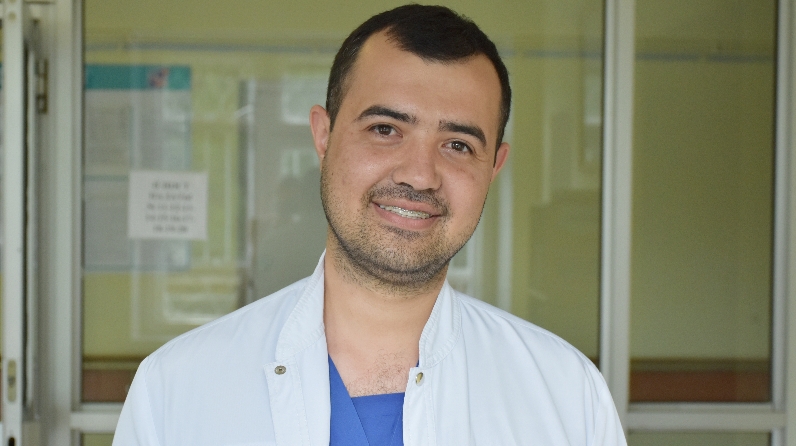
Nizhnekamsk medical institutions employ specialists who have come to us from other cities, regions, and even countries. Some of them have been working for 35 years, while others have only been working for a few months. But each of them has grateful patients. Among these doctors, the young traumatologist-orthopedist Anvar Tokhtaev. He is originally from Turkmenistan, graduated from the Medical School in Penza, and worked in the trauma department of the Nizhnekamsk CRMH since last November.
Anvar Samedovich's parents moved to Kazan from Turkmenistan, and both studied biology at the University of Chemical Technology. In 1991, after the collapse of the USSR, the family returned to their homeland. The future doctor graduated from high school with a focus on chemistry and biology. After college, Dr. Tokhtaev realized that he wanted to connect his life with medicine
About studies
"I left for Istanbul to apply for a medical school. The medicine is at the European level there, but the medical education leaves much to be desired. Therefore, many people study in Europe and return to work in their hometown. Thus, the choice fell on Russia - the education here is good. I came to Penza, but I was turned away. My secondary special education, which I received in Turkmenistan, did not count. It was impossible to be admitted with an incomplete secondary education. They offered me to finish an evening extension school and pass the Unified State Exam. So I did, and in 2011, after passing the exam, I was admitted to the medical school with no issues.
In the third year of school, I started working in a local hospital as a volunteer. There is a choice provided to have a clinical practice in different departments of the hospital. In addition to the trauma department, there was a department of hand surgery. That is where I worked the most, where we were trained, including in conservative, non-operative treatment, such as applying a cast correctly."
About Nizhnekamsk
"In Penza, we were offered a job either in a trauma center or in a polyclinic, and only then could we be transferred to a hospital. My friend and I wanted to operate right away. A friend accidentally found an online ad about a job in the hospital of Nizhnekamsk. My partner came here, settled in, and I was to arrive soon. But two weeks later, due to family circumstances, he had to return to Penza, and I just moved to Nizhnekamsk. Here I first operated together with the head of the Department, Viktor Vladimirovich Sizintsev."
"At first, it was hard indeed: work, home, work, home. I don't have anyone in all of Russia, not just in Nizhnekamsk. The team is very good; all the guys are young. I still don't know much about the city. I only know my hospital and the street where I live. But now all the information is available on the Internet, so there are no difficulties."
"People here are kinder and simpler than in big cities. When I turned to passers-by to ask for directions in Istanbul or Moscow, someone answered rudely, and someone ignored me. And here, people explain everything and even can lead you to it," the doctor laughs. It turns out that I understand the Tatar language well, since it is very similar to Turkish, Azerbaijani, Uzbek, and my native Turkmen, which I all speak. Colleagues talk to each other, and I understand their speech easily."
About complex cases
"There was a patient who cut off his finger with a circular saw. The finger rested on a single vessel. The patient pleaded: "Let's try to save it; you'll always have time to amputate it." We tried it and eventually saved it. I restored the tendons and replaced the bone. Of course, the motor activity was not preserved to its full capacity, but, at least, there is no cosmetic defect.
In fact, the development of hand surgery is essential for Nizhnekamsk. We have patients who have been injured in the workplace. Most often they are young people and suffer from the hand trauma. Now we send such persons to Kazan, but because of the four-hour ride, it could be late by the time they get there. Therefore, it would be good if we had modern microsurgical instruments. That way we would be able to help our patients ourselves."
About the main thing
Dr. Tokhtaev admits that he wanted to quit medicine only once, while in medical school.
"In the third year, there were many new subjects, plus I still worked in the hospital and did not have time to do anything at all. So I thought: "Should I quit it for good?" But I was advised to keep going and be patient because it would become easier and more enjoyable the next year. It indeed turned out to be that way."
The most important reward for a young traumatologist, as for any doctor, is to see how patients recover. " My results can be observed a couple of weeks after a discharge, when they come for an examination. I am pleased to see when everything is properly fused, everything bends and extends well. Of course, a lot depends on the patients themselves. We are happy when they leave healthy, smile, thank us, and wish us the most important thing, health."