Miraculous story of a rescue of the infectious diseases hospital of the Nizhnekamsk CDMH
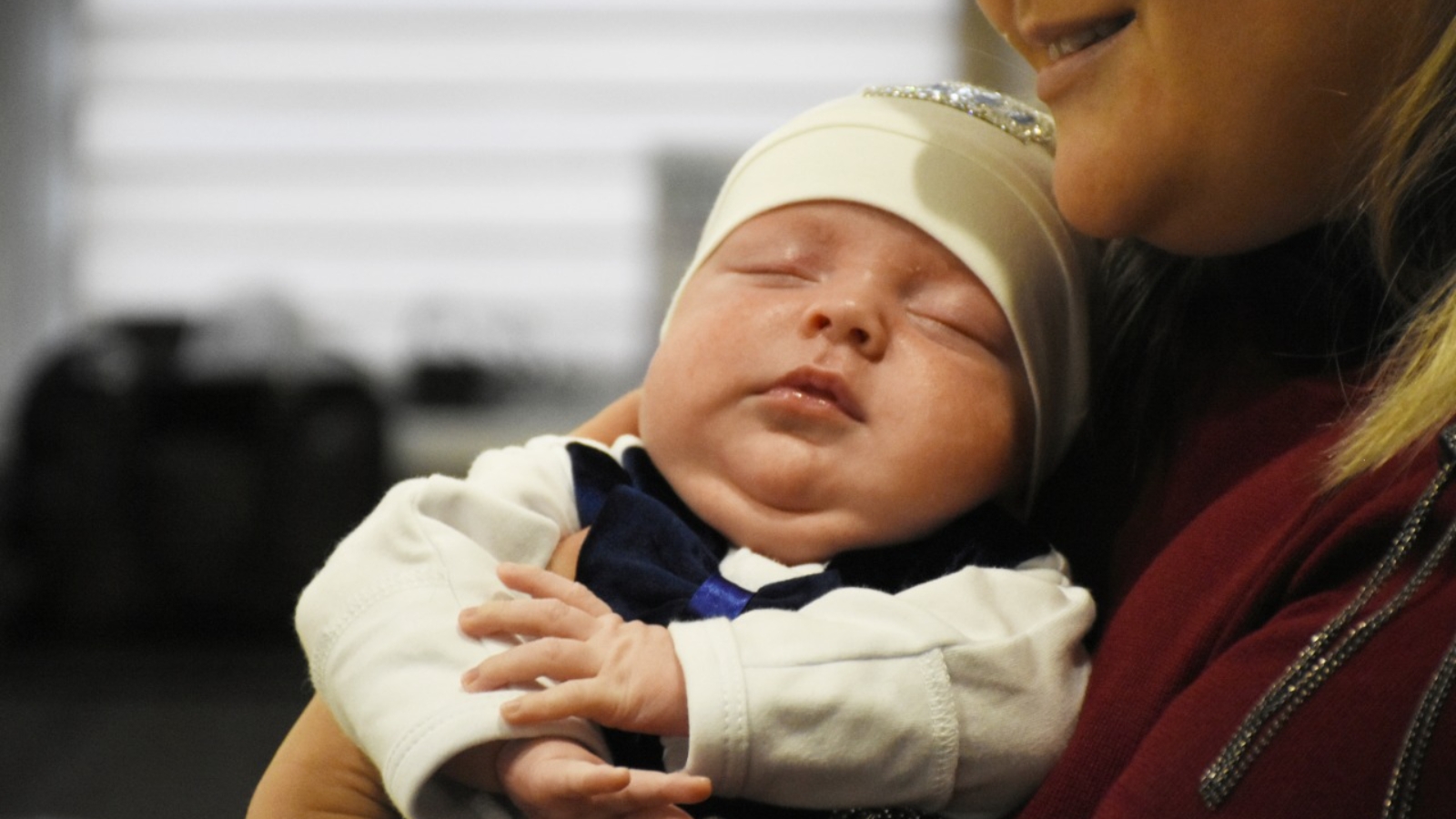
A miraculous story of the rescue, which happened in the infectious diseases hospital of the Nizhnekamsk CDMH, again became the topic for the plot of the First channel. The doctors saved a life of a mother of many children Tatyana Khramova, who during the fourth pregnancy contracted a coronavirus infection. Doctors had to make an emergency decision about a caesarean section and the baby was born a little early, but absolutely healthy.
On October 30, a 37-year-old resident of Kamskiye Polyany was hospitalized with a 20% lung demage. But despite the ongoing treatment over the next two days, Tatiana's condition worsened. Pulmonologist of the infectious diseases hospital Elvina Abyzova explained why doctors are afraid of pregnant patients: "They are very unpredictable - everything can be fine, but at some point a catastrophe suddenly happens. Unfortunately, this happened to Tatiana. Her condition was stable and she was receiving all the necessary medications. But the cytokine storm has begun – the catastrophe we fear. And at the 37th week of pregnancy, according to agreement with the Ministry of Health of the Republic of Tatarstan, a decision was made to have a caesarean section in order to start more aggressive therapy."
On November 2, Tatiana was transferred to the KCMC of Naberezhnye Chelny for the surgical operation, the son was born weighing 3,040 grams and 52 cm tall.
The woman was sent back to the hospital for further treatment, the baby was left waiting for his mother in the perinatal center. The patient returned with severe shortness of breath - a CT scan showed that 80% of the lungs were already affected. "Tatiana was immediately transferred to the intensive care unit," - recalls E. Abyzova. "I'll probably remember that awful night for the rest of my life." We were woken in the middle of the night; my colleagues and I arrived at the hospital and did not leave Tatiana until the morning. That night was a critical moment, and we knew that if we survived it, everything would be fine. Thank God that's what happened."
Tatiana spent a month in the hospital, 13 days on a lung ventilator. "A few days before I got to the hospital, I started to move slowly," Tatiana told us. - "I sinned on a heavy fetus. Then the eldest son lost his sense of smell, then I stopped feeling smells and tastes, and after a couple of days the temperature rose to 38 C and did not get off. I arrived at the hospital; I was sent for a CT scan and immediately hospitalized. And after I returned from the Chelny I was connected to a lung ventilator, I wanted to pull out all these tubes, but the doctors said: "You need to be patient, the device helps you to breathe and so you can recover." I was scared. I was afraid that I would not see my husband, children, that we had not yet completed the construction of the house. I tried not to worry about the child – my cousin from Naberezhnye Chelny took care of everything, she brought diapers and clothes to the perinatal center and texted to me about son every day. I knew everything was fine. However, I really wanted to breastfeed him, but the doctors explained that the blood-thinning drugs that I would take for about a year would have a bad effect on the baby. But this is not the worst thing; the main thing is that we are alive."
Tatiana spent a month in the hospital, 13 days on a lung ventilator. All this month, Tatiana's family and friends hoped and prayed. Mother Vera Viktorovna, who was also rescued in the hospital in September with 65-percent lung damage, said that she spent November in a delirium: "When my daughter was returned from Chelny, at 6 am her husband received a call from the head of the hospital. The son-in-law was afraid, thought what they would say about the worst. The head of the hospital said: "It is very hard for me to tell you about this, but I must inform you – Tatiana has become much worse." When we asked them if there is a hope, the doctors said: "There is always a hope." Every day I asked God not to leave children without a mother, but rather to take my life. All the relatives prayed. And now, as I walk down the street, I raise my eyes to the sky and thank: "Thank you, God, for not leaving children orphaned."
Tatiana's older children, Misha and Dasha, admit that they were afraid that they would never see their mother again. "My parents went to the hospital in the morning and ordered me to look after my sisters; they said that they would come in the evening. But in the evening, only dad arrived. Then we thought that it would be all right, but when my mother got worse, it became scary," - Mikhail shared. Teachers asked every day: "How is your mother? How's your brother?", - added Darya, wiping away tears. "And when my mother called and said she was going to be discharged soon, my hands started shaking. But when I saw my dad carrying her home in his arms, I was afraid again-what if something goes wrong?"
Tatiana was discharged on November 28. From the ambulance to the apartment, her husband and a paramedic accompanied her by the arms – so weak was the woman. For the first time, she was able to take her youngest son in her arms only two more weeks later – after discharge, she had to endure two-week quarantine; her mother-in-law took care of the baby.
"I thank my family, friends, and acquaintances, neighbors who prayed and helped my family. And, of course, I am eternally grateful to the doctors – my doctor Elvina Rustamovna Abyzova, and Rasul Narimanovich Musiev, who treated me very carefully and saved me several times, and Alexey Vladimirovich Cheremissinov – very decent, attentive, calm and affectionate. I don't remember all the names, but thanks to the nurses and orderlies – they were very kind and responsive not only to me. When I recovered, I noticed how they treat other patients – they will wash their eyes, wipe them all, support them all, clean up everything."
According to E. Abyzova, the doctor-patient tandem is very important in recovery: "In the case of Tatiana, a whole team was involved, as with any other patient. Our wonderful resuscitators, doctors of the intensive care unit, nurses, and orderlies did everything in order to recover Tanya’s health. Yes, we try, prescribe drugs. But it is very important that the patient fulfills all our prescriptions and adjusts to the fact that she should go home to her family, children – all this as a whole helps to defeat this terrible disease. Yes, this case was very hard in our practice, and we, medical professionals, rejoice like children when such stories end in this way."