One day with the palliative team of the Nizhnekamsk CRMH
How to keep calm looking at an elderly man gently caring for his wife after a stroke for a couple of years now? Or a 34-year-old guy who suffers from multiple sclerosis all his life and is so dependent on weather conditions in bad weather and becomes angry and brings his mother to tears?
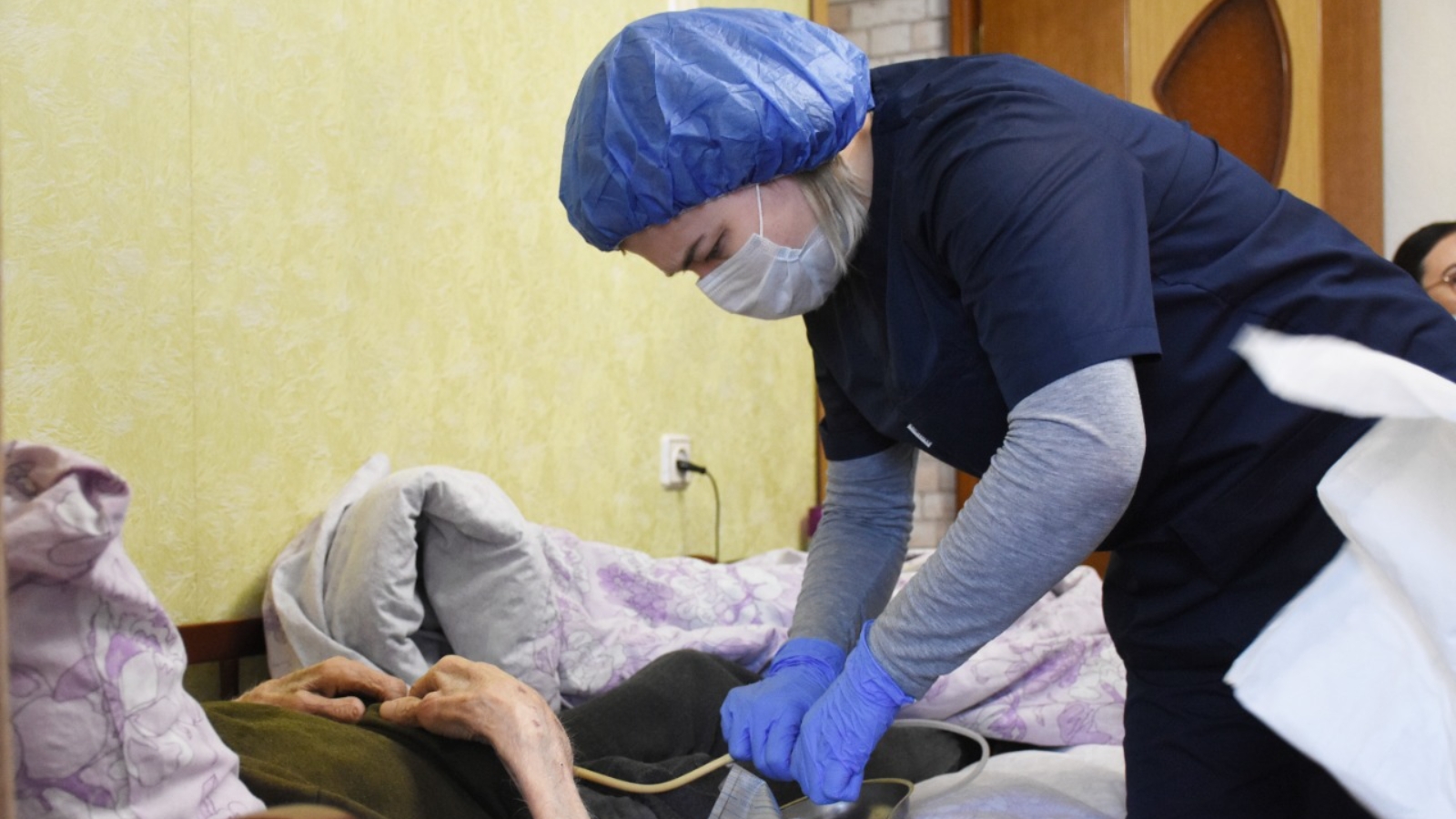
Our colleagues from the Nizhnekamsk Central Regional Multifunctional Hospital's field-based palliative care service face such stories every day. The team goes to the seriously ill residents of Nizhnekamsk to make the rest of their lives as easy as possible. Alexander Andreev, the head of the service, examines primary patients, gives recommendations; paramedic Aliya Matrosova, nurses Albina Mikhailova and Angelina Assit make injections, dressings, treat bedsores, and medical psychologist Gulsiyar Ismagilova talks with patients and their relatives. In general, the entire team morally supports those who need their help so that patients do not give up and do not fall into despair. We went with three of them to see several seriously ill patients. And let's face it: it is unlikely that we will be able to go on another such trip soon.
The first address is one of the houses on Sportivnaya Street. While we are driving, the paramedic Aliya Matrosova explains: usually, the team serves up to 15 applications per day. Most patients suffer from cancer. Some have fallen ill after strokes and injuries, especially many elderly people – with age, the bones become brittle. Due to careless movement in icy conditions, a person can remain disabled.
The 49-year-old female resident of Nizhnekamks, who was diagnosed with cervical cancer in the third stage in December of the year before last, is waiting for doctors at the Sports Arena address. Before that, there was a slight indisposition. The woman was treated, but, as she admits herself, not wholly – she just stopped paying attention to her condition. That month, during one of the gynecological examinations, she started bleeding. The doctor immediately sent the patient to the oncologist - tests, examinations, the Kazan oncological hospital, where she spent two months. And after chemotherapy, it was decided to perform surgery -metastases affected the intestines. During the surgery, the doctors removed the appendages and part of the intestine, leaving two stomas. These are holes in the abdomen, through which the contents of the intestine and bladder are removed in special bags. Now the woman lives with colostomy and does not get out of bed yet.
"Everything is scary for me," the woman laughs guiltily as Aliya Matrosova and Albina Mikhailova begin to change the packages.
"We are all medics here. Nothing can frighten us," Gulsiyar Ismagilova gently reassures her.
While the paramedics change the bags, give injections, I talk to the mother. An old woman never tires thanking the doctors: "My daughter was brought from Kazan on December 28. And she's not registered with me, I had to go to a therapist, then collect documents for registration of disability, I did everything alone. I didn't hear rudeness from any doctor and didn't see anger. The therapist, oncologist, and the palliative team are all excellent specialists. It's hard to look at your child in this state… The first days I fed her with a spoon, turned her over. Now she already walks slowly, eats herself. Do I hope? And how not to hope?... I'm a mother. I want my daughter to live."
Our patient admits that she was terrified. Until there was a need to go to Kazan, she did not tell anyone about the diagnosis to not frighten and not be pitied. "Then there was still hope – what if there was a mistake?" the woman wipes away her tears. She has big, beautiful eyes, and she's also very thin. When the patient raises her hand to straighten her hair, it feels like the bones are just covered with skin. "Only now I realized that it is necessary to live as harmoniously and fully as possible. There is more than just work, and I didn't understand it. I paid very little attention to my family. You must have enough time and energy for your family, for hobbies, for entertainment, and for your favorite work. Of course, you need to monitor your health. All this can be combined, and one can live quite happily. I hope I will still have time to do at least some of this. I am very grateful to our doctors. The team is very friendly, positive, they manage everything without any problems. It is good that there is such a service and that it is these girls who work."
We go to the second address. There lives a married couple; the spouse suffers from prostate cancer, practically does not get up, and has bedsores on top of everything else. The man is very fragile, and at first glance, it seems that a child is lying on the sofa. Aliya Matrosova and Albina Mikhailova do everything quickly and smoothly – injections, treatment of bedsores, dressing, while so kindly have time to talk to the patient and his wife. Everything takes a maximum of 10 minutes, and we are already going to the next patient. This elderly woman has breast cancer.
This patient can't take chemotherapy, and now her left breast is rotting alive. It's hard to look at such intimate moments. But not for the medical team, which gently but confidently, help the patient to lie down on the sofa, remove the bandage, treat and re-bind the bleeding wound, all the while asking if she was comfortable.
Another address and an elderly man who suffered a stroke five years ago, and three years later broke his hip neck and finally went to bed. He can move but practically does not get up and does not understand anything. Still, he watches with lively interest as the paramedics unpack the bag, take out the necessary tools for manipulations, and I try to photograph all this. This man is cared for only by his daughter-in-law, who is saved from stress by sedatives. While the paramedics are changing the patient's urinary catheter, a psychologist talks to the daughter-in-law: "You are taking care of a loved one, and this is a big burden. But you should not forget about yourself either. Go out for a walk, meet your friends, and just relax."
Another patient is a 34-year-old man who suffers from multiple sclerosis since birth, and he finally fell ill in the fall of 2018. While we are going to see him, Albina Mikhailova warns me: "This patient is weather-dependent, and today it is freezing. Therefore, as soon as you come in, do not get caught in his eyes. Immediately go to the other room so that he does not start swearing." We are met by a smiling mother, and, as it turned out, the patient is in a great mood today. We were introduced, the young man was embarrassed and suddenly began to flirt with everyone.
Later, my colleagues explained to me that such a good mood is a rarity. One of the symptoms of multiple sclerosis is aggression, and the weather-sensitive patient becomes even angrier. This guy knows that he will never be able to stand on his feet, and his mother will take care of him for the rest of his life. The young man insists that he be sent to an orphanage, and his mother, of course, does not agree. This makes him even more angry and desperate, causing him to swear and insult his mother. The unhappy woman runs away from home in tears. She calls the psychologist Gulsiyar Ismagilova to speak out, get support and calm down. The doctors also got it – more than once, Rustem broke down on the paramedics.
The next address was the heaviest. We are met by an older man with an officer's bearing: "Come on in, Lubasha's in the room." Lubasha – his wife, who was broken by a stroke. She doesn't get up, can only say a few words, and mostly mumbles. "I ask her once:" What are you mumbling about?" the husband tells us. "And Lyubushka answers: "That's how I talk."
I watch as a man turns his wife over, wipes her with water, helps the paramedics in any way he can, asks them for advice, and goes to the pharmacy to buy the necessary medicines.
"He loves her very much," says A. Matrosova. "We also cry sometimes; it's normal. Unfortunately, not all patients receive such good care. Everyone listens to our recommendations, but few people follow them. For example, suppose an immobilized person is not turned over all day. In that case, bedsores may appear, especially in the elderly – their skin is not as elastic as in young people and thins faster. That is why I am so happy when we come to a call and see that our patient has no bedsores and the linen is clean and fresh; it shows that the person is really taken care of. And this is much more difficult than our work.
The nurse Albina Mikhailova remembered a patient who had her ear removed due to basal cell carcinoma. Doctors came to treat the wound, which grew more and more.
"We did the dressings very carefully and for a long time. We had to soak the dressing material because it dried to the wound," A. Mikhailova shared. "The patient was very interesting, always met us, but suffered a lot because the wound hurt so much that in her last days, the woman took large doses of morphine. She passed away in March last year. I try not to let the patients get too close to me, but we still pass everything, though. Some patients suffer from pain very much. It hurts, it hurts, and nothing helps. Such people live out of their last strength and probably pray to god that he will take them away soon and their torment will end. Most of the patients have relatives who take care of them. Some even seek our arrival with aggression. For some reason, people think that our team works as an ambulance and must arrive after 15 minutes of the call. They can also be understood since they do not know how to help their relatives, do not know how to care for them, and get an injection. In fact, we serve primary calls for two days, then, if necessary, we go to the patient once or twice a week, we go to someone every day. At first, everyone is wary of us, but then we quickly get used to each other. Sometimes, after a person dies, their relatives come to us, ask how we are doing. There are also such cases when you are surprised at the coldness and cruelty. One day we went to see an oncological patient, and his ex-wife met us. She never approached him, never told us anything, never showed us anything. I understand everything, maybe the man himself treated his wife badly, but now he needed help. And some lonely people can not eat on their own or go to the toilet, and there is no one to help them. I feel sorry most of all. When we come to the elderly spouses, we immediately understand who to look up to. Usually, if someone in a couple of age starts to get sick, then the second one takes very good care of the other. People have lived together all their lives, for better or for worse. Now, at the end of their journey, they also stick together no matter what.
We only spent a couple of hours with the palliative care team. It was enough to cry, think about life and come to our senses. Our minor problems, which upset and irritate us every day, are just nonsense compared to challenges people experience daily. These people take care of a seriously ill relative and understand that he will either leave soon or live in torment for many more years. And patients who are ill themselves also know that they will go soon. But still, despite all the fears and sorrows, in each case, we saw the most important thing from both patients and our colleagues – the desire to help and relieve pain, compassion, and love.