Tatyana Yaryoma Akimovna, the head medical nurse of the Nizhnekamsk CRH, celebrated her 85th birthday
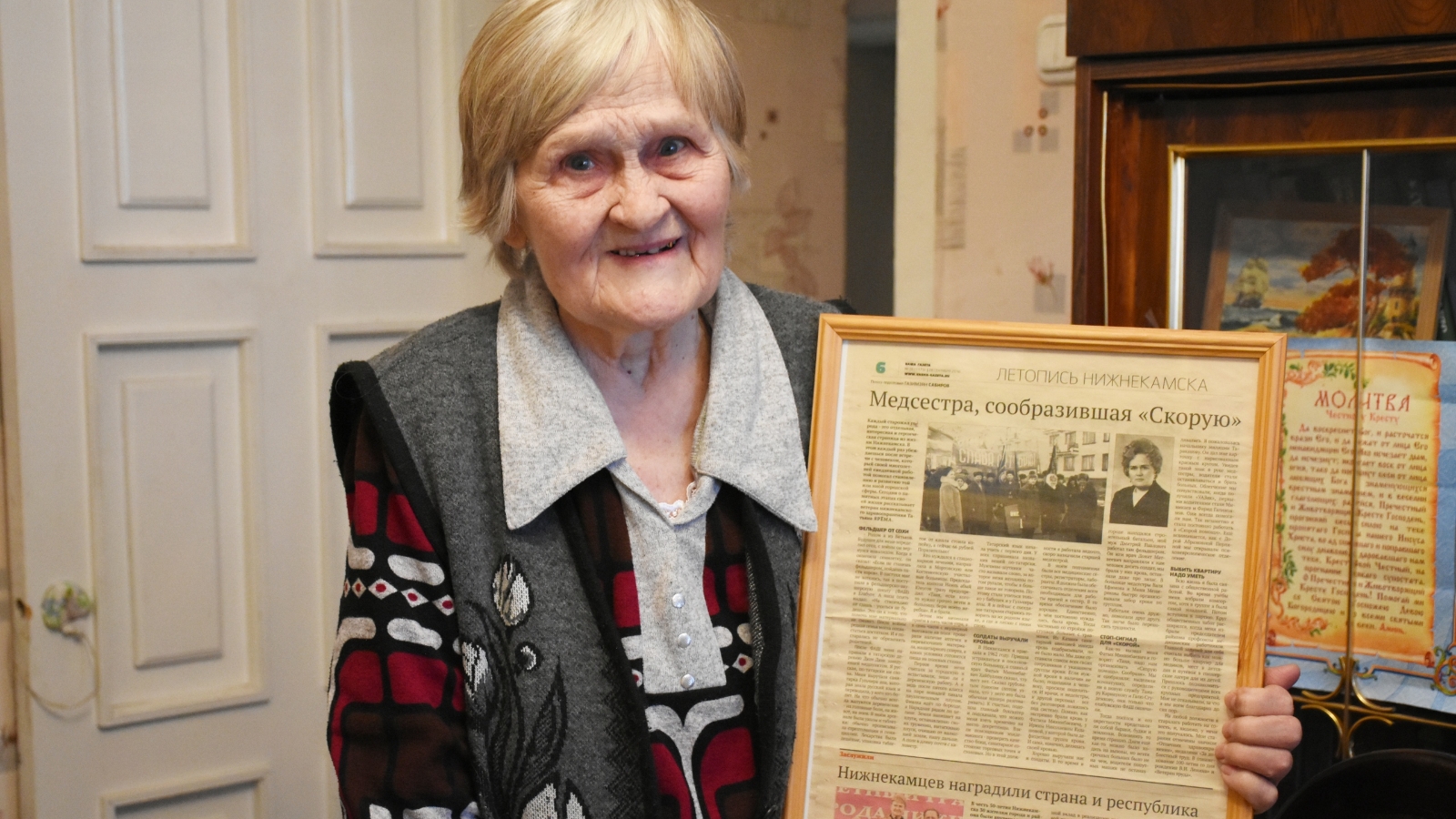
Tatyana Yaryoma Akimovna, the head nurse of the Nizhnekamsk Central District Hospital, celebrated her 85th birthday with optimism and in good health. The Chairman of the Board of Health Veterans Lyudmila Chernova and Deputy Chairman of the Council of Veterans of Farsia Kalimullina congratulated birthday celebrant. The hero of the occasion greeted them like family: "The closest people with whom we have been through a lot together!".
Tatyana Akimovna is considered one of the pioneers in Nizhnekamsk medicine – she was the chief assistant of the first chief physician Fatykh Khaybullin in village hospital. She was responsible for providing the medical institution with blood, helped in the formation of the ambulance service.
After graduating from the paramedic-midwifery school in Yelabuga and working in the village as the head of the medical center in 1962, Tatyana Akimovna came to Nizhnekamsk. She came to get a job in the village hospital, but the chief doctor Fatykh Khaibullin said that there were no vacancies. But the chief accountant suggested that the girl can be accepted in the place of the woman on maternity leave. So Tatiana became an assistant epidemiologist – her duties included checking the quality of food and the sanitary condition of retail points and canteens. But in this position she had to work for a short time, soon Tatiana was appointed as a senior nurse.
Now Tatyana Akimovna had to provide the departments with everything necessary for the work of doctors and nurses. The only thing that was constantly needed was blood – then patients with injuries often admitted from the construction site. From Kazan, blood was given by air ambulance, but this was not enough. The hospital even compiled a list of employees with an indication of the blood type, and if necessary, the person was asked to share the blood. Doctors, nurses, and other staff all adapt the system without talking. They urgently took the blood from Fatykh Minnibaevich and Irina Kudashova Nikolaevna.
I lived next to the hospital in a barrack, and on Saturdays and Sundays I set off to check how much blood I had and what types – nothing else interested me," recalls T. Yaryoma. Once Fatykh Minnebaevich invited me to the rounds. We went to the ward, and there was one of the patients – a soldier who had a ruptured liver due to an injury at work. We ran out of blood then. So Fatykh Minnebaevich around all patients talking about this soldier to me: "Do you know that he's going to die because of you?" I flew out of the ward like a bullet, I thought I would quit and go to work on a construction site – it was so insulting, no one had ever insulted me like that! I shut myself up in my room and burst into tears. Nurse said, that Khaibullin is calling you. I say, "I won't go." The nurse ran away, and then came back again: "The chief doctor is calling to the operating room." Well, I think something's wrong, I should go. I said: "Fatykh Minnebaevich, I came." And he asks: "Are you crying, perhaps?". I don't say anything. And he continues: "I'll finish it, and then we'll talk about it. You know how hotheaded I am. I'm sorry, okay?" And I left without a word. It was a shame that I was scolded for nothing, in front of everyone, and even more so in front of a dying patient. That guy, by the way, recovered, and I forgave Fatykh Minnibaevich, of course."
Once Fatykh Minnebaevich called the head nurse and said, "Tanya, I need us to arrange an emergency medical setting. Figure it out." And they allocated a small room, assigned Tamara Karnaukhova and Galya Studenkova, who had just graduated from the Yelabuga medical and obstetric school, to the new service.
"It's scary to remember that time. During the day, it was possible to admit the calls, but there was nothing to transport urgent patients, the drivers of passing cars did not stop. I complained to the police chief Tarakanov. He gave me a cardboard with a red circle drawn on it. Seeing such a sign in the nurse's hand, the drivers began to stop and take the patients. We felt relieved when we received the UAZ."
In difficult times, Tatyana Akimovna relied only on the family: "Sometimes, the commission arrives, they all need to be fed, while you clear the tables, and it’s already two or three o'clock in the morning. The commission takes you home, and there the husband boils the kettle: "You're probably hungry, let's at least drink some tea, and sit down." So I still live so with gratitude in my heart. The most important thing for any doctor is to treat his patients without arrogance, with kind soul, in a human way, without rudeness and division into ranks. And with colleagues, too, it is also necessary behave without anger and gossip."