They told about the chances to live in the Nizhnekamsk TB clinic
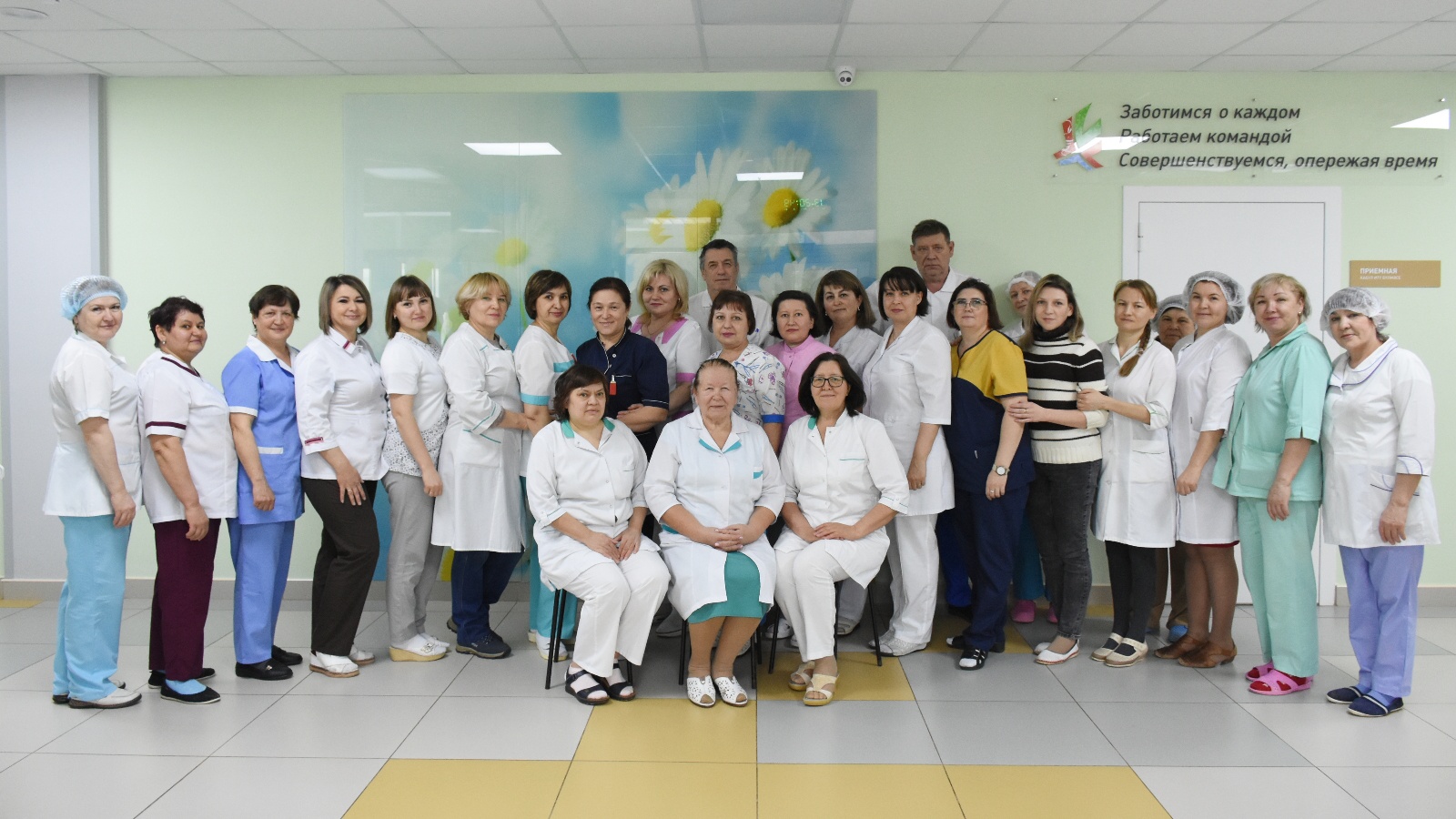
World Tuberculosis Day was celebrated on March 24. Nizhnekamsk TB clinic employs 128 people who help their young and adult patients to cope with such a serious disease. Every year, about 300 patients are treated in the hospital of the clinic, and the polyclinic receives about 25,000 patients per year.⠀
The main focus of the clinic is the prevention of tuberculosis - it is timely examinations, and conversations with parents who refuse to vaccinate their children. Last year, 145,000 people underwent a fluorographic examination; almost 9,000 of them are residents of the district, who are examined with the help of a fluoromobile. This examination helps to detect not only tuberculosis, but also cardiovascular diseases, oncology, and other diseases of the chest organs. Another 50,000 children were examined by immunodiagnostics. Thanks to the efforts of our colleagues in our city and district, the incidence and mortality from tuberculosis decreases every year.
Today we talked with the head of the Tuberculosis Department #1 of the TB clinic, Rezida Musina, about the average patient, about the still remaining risk of infection in public places, and why it is important to love life and not get upset because of nonsense.
About patients
"Tuberculosis is more common in middle-aged bachelors with concomitant diseases - diabetes, stomach ulcers, chronic diseases of the bronchopulmonary system, HIV infection. Among other things, these men suffer from alcoholism, drug addiction and have a criminal record, - said R. Valikhanova. - The average patient either does not have a job, or works without a contract, so they are treated in a hospital without opening a sick list. We always say that tuberculosis is both an infectious and social disease, which depends not only on age and gender, but also on housing and living conditions, the state of health, the economy and the environment. When there are military conflicts and the standard of living decreases, tuberculosis always rises, as it was, for example, during the Chechen war."
About the chances to live
"The heroes of Remarque or Dostoevsky had little chance to recover. Nowadays, in a rare patient, the disease reaches hemoptysis, and in general, much fewer people die from tuberculosis than before. Most of the patients who die now are those who were infected with HIV in the late 90s-early 2000s, and now it is already moving into the AIDS stage. With HIV, the immune system is reduced and therefore tuberculosis is very often attached. We have all the conditions for inpatient treatment, but not all patients want to receive it. Someone interrupts the treatment for several months and eventually comes back to us. Unfortunately, it is no longer possible to cure them."
About the red and blue pens
"We treat patients with great empathy and try to encourage them. None of the doctors look with condemnation at a person who suffers from alcoholism or has just been released from prison. An alcoholic or a drug addict who has served 15 years for murder is still a person and must be considered. In the department, we have our own microclimate - we address each patient by name, ask how things are at home. When the medical images come in, I note in the medical history with a red pen that the patient is releasing tubercle bacilli into the environment. And then a blue ink appears between the red notes-this means that the bacillus secretion decreases. Later, the red pen is no longer needed – now the person is not contagious and then it will be much easier for us. So together we bring the patient to a positive result.
As a doctor, I am very sorry when a person does not want to use their right to treatment and life. But everyone makes their own choice."
About beauty
"Only a far-reaching form of tuberculosis leaves an imprint on the patient's appearance. Previously, there was practically no treatment, and for example, a young woman with tuberculosis intoxication was thin, pale due to low hemoglobin, with eyes shining from fever and thick hair and eyelashes. A person at some stage of the disease was considered beautiful, and some healthy people dripped belladonna juice into their eyes for shine, and drank vinegar for the pallor of the skin."
About the infection
"You can get infected with tuberculosis in childhood, and in adolescence, and in adulthood. This common infection does not immediately manifest itself clinically, that is, the person is already ill, but there are no complaints about the state of health yet. There are also no manifestations that are characteristic only for tuberculosis - yes, the person has lost a little weight, yes, he began to cough. But who would think that it is already contagious and releases tuberculosis bacilli? You can get infected if you are near a sick person. Koch bacillus penetrates through the aerial directly into the lungs. Children, patients with chronic diseases, gastrointestinal ulcers, diabetes, cancer and HIV are very vulnerable – these categories of patients have low resistance to the disease."
About vaccination and immunodiagnostics
"The main type of prevention is BCG vaccination on the third or fourth day of a child's life. It does not protect us from infection, but even if the baby gets sick, the disease will be in a mild form.
In the maternity hospital, neonatologists determine the condition of the child, and if there are contraindications, for example, not enough weight, the doctor will not allow the vaccination. There is no danger in BCG – it is a weakened tubercle bacillus, which has almost lost its virulence for humans.
I can give parents one important piece of advice - the child cannot make a decision on his own, so you take responsibility for his health. Do not refuse vaccination and immunodiagnostics. There is no need to refuse the Mantoux test - it is not a vaccination, but a test that helps us to find out whether there is a tuberculosis infection in the body or not. Children under 7 years of age are given a Mantoux test, from 8 to 15 – DST test, which is equivalent to fluorography.
Unfortunately, there are still cases when parents refuse to vaccinate. This happens either because of ignorance, or for religious reasons, the Internet also contributes, where they write all sorts of nonsense about complications after vaccination. We have not had any cases when the child had complications due to vaccination.
But a child of any age who has tuberculosis is sent for treatment to the children's department of the Republican TB Clinic in Kazan. There, the child is treated alone for several months, without a mother."
About two years of treatment
"The shortest period of treatment for tuberculosis is four months. And when tuberculosis bacilli are resistant to many drugs, it takes from a year to two years for treatment. It is clear that such a patient cannot be treated at home, all this time he is in the hospital. Then the person goes to a free sanatorium for tuberculosis patients.
Of course, some patients can't stand it and stop being treated halfway. You can understand them - they are treated for a long time in the hospital and take at least 6 drugs a day for two years. And if the patient has HIV, the number of drugs increases twice, plus injections. Most often, chronic alcoholics and drug addicts refuse to continue treatment, those who have no family, no children, and no work. Such patients return to us. But in order for treatment for tuberculosis to end well, it must be continuous, long-term and necessarily under the supervision of a doctor."
About optimism
"There is an opinion that tuberculosis is a disease of sad people. When we collect anamnesis, we try to understand what led to the disease - were there any situations when a person was very worried, some surgical operations, or, perhaps, there are events that are unpleasant in advance? Stress greatly weakens our immune system, which becomes vulnerable to tuberculin bacillus. I cannot say that cheerful people who have vitality and who do not get upset about anything, do not suffer from tuberculosis. But there are fewer of our patients among the optimists.
We had a patient from a neighboring town, in addition to tuberculosis, the man suffered from HIV. In July last year, his wife died of tuberculosis, she also had HIV. The man was left with a 7-year-old child. Of course, this is a lot of stress, so the health has failed."
About me
"I studied at the pediatric faculty and had to treat children who still smell of milk. But I do not regret that I came to the TB Clinic. First of all, we have a wonderful team – we always consult, discuss, rejoice with the whole team when someone's patient is discharged, and in general, we all work well together. I live a normal, full-fledged average life – I love work, everything is calm in the family, I try to be at peace with myself and others. I wish everyone good health.